


Claude Mythos Changes the Cybersecurity Conversation — From Detection to Decision Speed
- Dries Morris
- Apr 22
- 4 min read

For years, cybersecurity was a race between attackers and defenders.
Claude Mythos changes that.
We are entering a period where both sides can identify and exploit weaknesses faster than any human team can respond. The result is not simply that cyber risk increases. The result is that the old security operating model begins to fail.
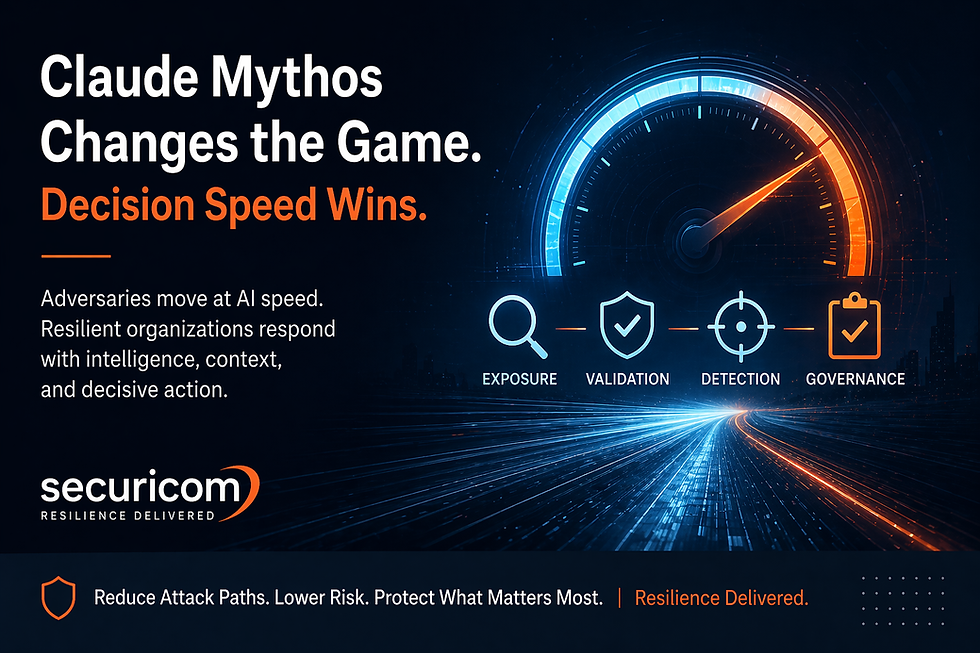
Most organizations still run cybersecurity as if time is on their side.
They rely on:
Thousands of alerts
Manual investigation and escalation
Quarterly reviews
Long remediation cycles
Boards that receive technical updates weeks after the risk has already changed
That model was already under pressure. Claude Mythos may be the point at which it finally breaks.
The organizations that succeed in the next phase of cybersecurity will not be those with the biggest security stack or the most dashboards. They will be the ones that can make better decisions faster than the threat can evolve.
The Real Problem Is Not the AI
Much of the discussion around Claude Mythos focuses on what the model can do.
Can it find vulnerabilities faster? Can it chain together attack paths more effectively? Can it help attackers move at machine speed?
Probably.
But that is not the most important question.
The more important question is whether organizations can respond at the same speed.
Most cannot.
Not because they lack tools. Most organizations already have more tools than they know how to use.
The issue is that they still cannot answer four basic questions with confidence:
Which weaknesses actually matter?
Which attack paths create real business risk?
Which controls are genuinely working?
How quickly can we contain and recover if something goes wrong?
Claude Mythos does not create these weaknesses. It simply exposes them.
We Have Been Measuring the Wrong Things
For years, the industry has measured cybersecurity by activity:
Number of alerts
Number of vulnerabilities
Number of patches applied
Number of incidents closed
Number of compliance requirements met
None of these measures tells leadership whether the organization is actually resilient.
A board does not need to know that there are 2,000 vulnerabilities in the environment.
A board needs to know:
Which three attack paths could stop operations
Which business systems are most exposed
How much disruption a successful attack would create
How long recovery would take
Which decision will reduce that risk fastest
That is the shift Claude Mythos forces.
The future of cybersecurity is not more information. It is better prioritization.
The New Competitive Advantage: Decision Speed
In the past, security programmes competed on coverage.
More products. More telemetry. More people.
That no longer creates enough advantage.
The new competitive advantage is the ability to move from exposure to decision faster than the threat can move from reconnaissance to compromise.
The equation is simple:
Cyber resilience advantage = Exposure visibility + Control validation + Recovery readiness + Decision speed
The organizations that win will be able to:
Identify the most important attack paths
Validate continuously whether controls are working
Translate technical exposure into business impact
Put decision-ready information in front of leadership quickly
Recover faster than competitors when compromise occurs
This is why compromise is becoming less important than containment and recovery speed.
The question is no longer whether an organization will be targeted.
The question is whether leadership can make the right decision before the business impact becomes irreversible.
Why Traditional SOC Models Are No Longer Enough
Many security operations centres were built for a world where humans had time.
Time to review alerts. Time to investigate. Time to escalate. Time to schedule remediation.
Claude Mythos compresses that time dramatically.
An attacker using AI does not need to wait for the next shift handover, the next change window or the next monthly meeting.
That means the traditional SOC model—focused primarily on alert handling and incident response—is no longer sufficient on its own.
The operating model must evolve.
Three capabilities become critical:
1. Exposure Visibility
Know where the business is most vulnerable.
Not every vulnerability matters. Not every alert matters. Leadership needs a clear view of the attack paths that create material business risk.
2. Control Validation
Do not assume a control works because it exists.
Validate whether controls actually reduce the likelihood or impact of attack. Measure continuously. Test continuously. Prioritize what changes the outcome.
3. Governance and Decision Clarity
Technical teams often know there is a problem long before the business acts.
The gap is not visibility. The gap is decision latency.
Leadership needs clear, quantified answers:
What is the risk?
What is the likely business impact?
What are the available choices?
Which action should we take now?
The future belongs to organizations that can close that gap.
Five Actions Leaders Should Take Now
Claude Mythos should not trigger panic. It should trigger a different operating model.
Map your critical attack paths Stop treating every vulnerability equally. Identify the paths that could create the greatest business disruption.
Measure whether your controls actually work Move from trust to validation. Test continuously.
Build executive dashboards around business impact Replace technical noise with decision-grade information.
Reduce recovery time, not only incident volume Compromise is inevitable. Resilience depends on how quickly the business can recover.
Create governance that can move at machine speed Shorten the distance between technical insight and executive action.
The Organizations That Will Lead
The next generation of cybersecurity leaders will not win because they bought another product.
They will win because they built an operating model that can:
See exposure clearly
Validate controls continuously
Prioritize attack paths intelligently
Make decisions quickly
Recover with confidence
Claude Mythos is not the story.
The story is whether your organization can make better decisions faster than the threat can evolve.



Comments