


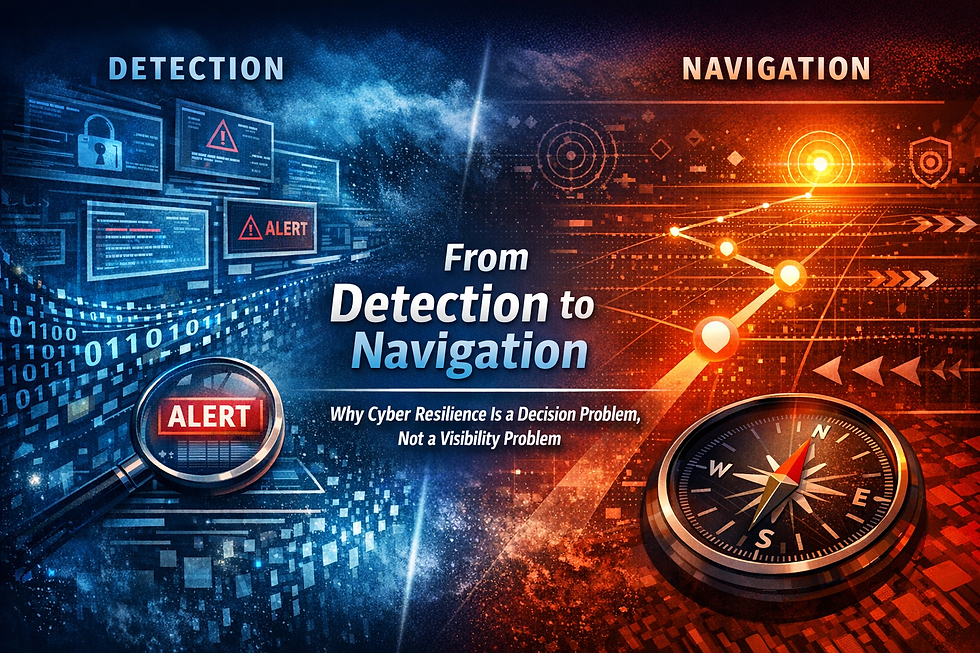
From Detection to Navigation: Why Cyber Resilience Is a Decision Problem

The cybersecurity industry has a blind spot.
For years, organizations have been told that better security comes from better visibility:
More tools
More alerts
More dashboards
And to some extent, that was true.
But today, that model is breaking.
Because the problem is no longer what you can see. It’s how you decide what matters — and what to do next.
The Illusion of Progress
On paper, most organizations appear more secure than ever:
SIEM platforms ingesting massive volumes of data
EDR tools monitoring every endpoint
Attack surface platforms mapping exposures continuously
Yet in practice:
Security teams are overwhelmed
Critical risks are missed
Response times are inconsistent
Leadership lacks clarity on real business impact
The result?
More input. Worse decisions.
Cybersecurity Is Now a Navigation Problem
Modern environments are not static — they are constantly shifting:
Cloud infrastructure changes daily
Identities and permissions evolve continuously
Attack surfaces expand beyond traditional boundaries
Threat actors adapt in real time
In this environment, security is no longer about building higher walls.
It’s about navigating complexity under uncertainty.
Introducing the PIOSEE Model
A useful way to understand this shift is through the PIOSEE model — a decision framework used in dynamic systems:
Perceive – What is happening?
Interpret – What does it mean?
Orient – What matters to the business?
Select – What should we do?
Execute – Take action
Evaluate – Did it work?
Most cybersecurity programs invest heavily in the first step:
Perception
They collect vast amounts of data.
But they struggle with everything that follows.
Where Most Security Programs Break Down
Let’s map reality to the model:
Stage | What Typically Happens |
Perceive | Massive telemetry from multiple tools |
Interpret | Fragmented context across platforms |
Orient | Limited mapping to business impact |
Select | Too many options, unclear priorities |
Execute | Manual, slow, and siloed |
Evaluate | Compliance-focused, not outcome-driven |
Most organizations are stuck between Perceive and Interpret — generating insight, but not achieving clarity.
Meanwhile, Attackers Are Already Navigating
Threat actors operate very differently.
They:
Continuously probe environments
Adapt based on feedback
Identify the most efficient paths to impact
Automate execution
Learn and iterate rapidly
In other words:
Attackers are navigating. Defenders are monitoring.
This asymmetry is where risk lives.
The Role of CTEM and Attack Path Management
Concepts like Continuous Threat Exposure Management (CTEM) and attack path analysis are gaining traction — and for good reason.
They shift focus from isolated vulnerabilities to how risks connect and evolve.
But there’s a common mistake:
Treating them as the solution.
They are not.
They are inputs into a better decision system.
Without the ability to:
Prioritize based on business impact
Translate exposure into action
Execute and validate continuously
…visibility alone does not reduce risk.
The Shift: Building a Cyber Navigation System
Organizations need to evolve from security operations to decision systems.
At Securicom, we frame this as three integrated capabilities:
1. Execution (Acting with Speed and Precision)
Automated response and containment
Defined playbooks
Consistent operational delivery
2. Intelligence (Understanding What Matters)
Continuous control validation
Exposure and attack path intelligence
Real-time feedback loops
3. Influence (Driving Better Decisions)
Business impact mapping
Risk prioritization aligned to outcomes
Board-level clarity and reporting
This combination transforms security from:
A reactive function
Into:
A continuous navigation system
What Good Looks Like
Mature organizations no longer ask:
“Are we secure?”
They ask:
“Which paths lead to real business impact — and what are we doing about them right now?”
They can:
Focus on a handful of critical risks instead of hundreds of alerts
Align technical issues with operational and financial impact
Continuously validate whether their decisions are working
A Final Thought
AI is accelerating both attackers and defenders.
But it introduces a new risk:
More capability without better decision-making
And that doesn’t reduce risk — it amplifies it.
The Bottom Line
The organizations that succeed in the next phase of cybersecurity will not be those with:
The most tools
The most alerts
The most AI
They will be the ones with:
The best decision systems
Start the Navigation Conversation
At Securicom, we help organizations move beyond detection and visibility — toward continuous, decision-driven cyber resilience.
If you're ready to shift from monitoring risk to navigating it, let’s start the conversation.


Comments